The Enduring Mystique
of the Saloon
PRESENTED BY

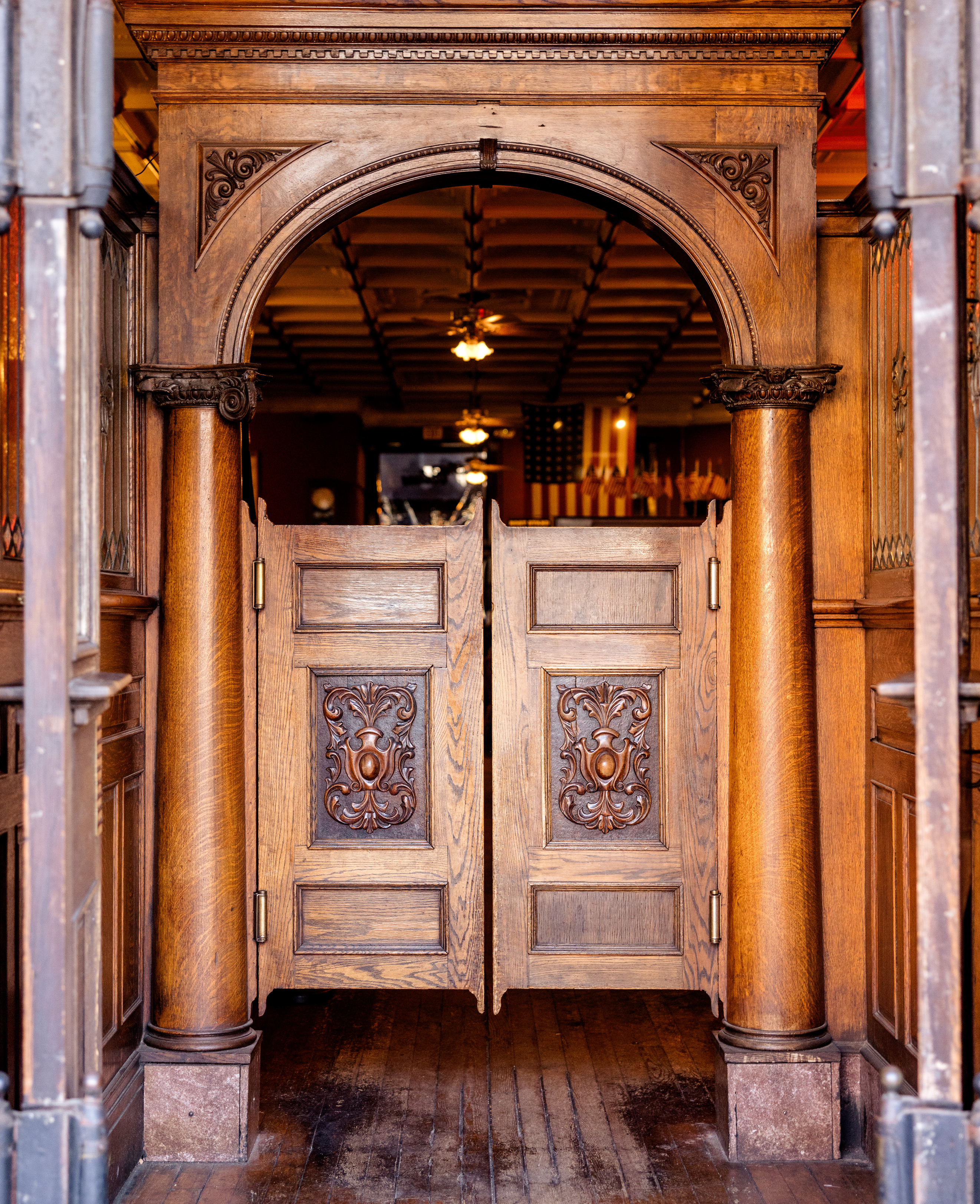
The saloon door. It is the most recognizable storytelling device in Western movies and maybe all of American cinema. When a saloon door swings open, it portends drama. Icy stares will be cast. Pistols pulled. There may be blood.
I think of Clint Eastwood, in “For a Few Dollars More,” half opening a saloon door and leaning on it as he surveys the scene inside through those famously squinted eyes. Eastwood drapes his forearm over the door like it’s a fence rail. Rain falls in sheets behind him. A Mexican poncho covers his shoulders, and a freshly lit cigarillo is clamped in the corner of his mouth.
This is how I dream of entering a saloon.
Instead, on a sunny February day in Cave Creek, Arizona, I pull open the door of a saloon—it’s just a regular door, not a swinging one—and step inside Harold’s Cave Creek Corral, and no one notices, not even the hostess. An iPad is tucked under my arm. I’m wearing jeans, a t-shirt and sneakers. Sneakers, for God’s sake. In a saloon.
The man I’m looking for will be wearing cowboy boots, I’m sure of it. This man isn’t a cowboy himself—he’s a man of letters. An author. An historian. A folklorist. He arguably knows more about Arizona’s “Old West” past than any human alive, and I’m hoping he’ll help me answer this question: Why, after the passing of 150 years—after the stagecoach has been replaced by Waymo and the telegraph has given way to TikTok—does the mystique of saloons endure?
When I find Marshall Trimble at the bar, his attire does not disappoint. Boots. Denim. A shirt with pearly snap buttons. His cowboy hat—black with a fairly stingy brim—is pushed back off his forehead. The hat is well worn, softened by age and the elements, not unlike the man who sits under it.
A lifelong Arizonan, Trimble was born in 1939, in Mesa, and he spent most of his boyhood in Ash Fork, a little railroad town along what is now Route 66. After stints as a semi-pro baseball player, a Marine and a folk musician, he devoted his life to studying the American West and sharing his knowledge with others. He’s been a professor, a radio and TV host, and, since 1997, the official State Historian of Arizona. He’s authored about two-dozen books, including titles like “Arizona Outlaws and Lawmen” and “Roadside History of Arizona.”
Marshall Trimble has heard it all. He’s a towering figure. And the last thing I want to do is come at him with some half-cocked question that lands beneath his expertise. So I roll into a semi-rehearsed ramble about the symbolism of saloon doors—how they’re the literal gateway to so many of the things that contribute to the mythology of the American West: barroom brawls, gunplay, gambling, rotgut whiskey. Finally, I arrive at the question: “Can you talk a little bit, Mr. Trimble, about the saloon door as a storytelling device in Western cinema and literature?” I sit back in my chair, pleased with myself. Trimble looks at me, his blue eyes soft beneath wispy white eyebrows. “Well, here’s the thing,” he says, cracking a grin that’s at once knowing and mischievous. “Saloons didn’t really have swinging doors.”


Westerns can’t be trusted.
One of the most famous Westerns ever, “The Searchers,” directed by John Ford and starring John Wayne, begins with a black title card that reads “Texas 1868,” and then the very next thing you see is a silhouetted woman opening a ranch-house door to reveal the glory of Monument Valley. God bless Texas, but it ain’t got landscapes like that. Monument Valley is, of course, located in far-north Arizona, within the Navajo Nation, and it would take John Wayne a month to ride there from Texas, assuming he had a good horse.
When it comes to saloons, Westerns likewise lead us astray.
“The saloon of fictional Westerns is a concoction,” says Bob Boze Bell, the executive editor of True West magazine, which has, since 1953, chronicled the stories and characters of the Old West.
Bell is an old friend of Trimble’s, and his magazine’s offices are just down the road from Harold’s Cave Creek Corral. He joins us at the bar, and soon he and Trimble are riffing on all the things movies and TV shows get wrong about Old West saloons: They didn’t have brothels upstairs. They served good booze and often fancy cocktails, not rotgut whiskey. They sometimes hosted religious services and funerals. And fighting, believe it or not, was rare.
So maybe Westerns get details wrong and play loose with the facts. Their veracity is beside the point. They still bottle the spirit of the Old West and distribute it to the world. And the world drinks it up. Westerns make you want to push open the swinging doors of a saloon. They make you want to lean against an old bar and think about the characters who leaned there before you. They make you want to slip into the role of mysterious stranger, if only for a few hours.
In Arizona you can still do these things. In Arizona, saloons aren’t merely vestiges of the past—they survive, ornery and unbroken. And most of them don’t shy away from the mythology constructed by Westerns. In fact, they lean into it.
“See that there,” says Victor Villalta, owner of La Gitana Cantina, in Arivaca, pointing at three dime-sized stickers on the ceiling of his bar. “That’s where the guy shot, bang bang bang, and everybody screamed and ran out.” Villalta has just described to me a long-ago brawl that was broken up when a patron unholstered a sidearm and shot at the ceiling. Villalta wasn’t around when the shots were fired—he’s owned La Gitana for only a few months—but the stickers commemorating the event are the first thing he shows me when I walk into his saloon.
“You used to have to check your gun with the bartender,” Villalta says. “And after you paid your tab, you’d get it back.”
La Gitana is a humble little cantina on the side of the road, 11 miles north of Mexico. The adobe building that houses La Gitana has been a staple of Arivaca for more than 120 years. Before it became a bar, in the 1940s, it was a hay barn for 10th Cavalry Buffalo Soldiers garrisoned across the street. Their job was to protect against violence spilling across the border during the Mexican Revolution. According to Arivaca town historian Mary Kasulaitis, the saloon was named after a former owner’s favorite Spanish poem—most likely “La Monja Gitana” (“The Gypsy Nun”) by Federico Garcia Lorca. A tapestry depicting a dancing gypsy hangs next to the bar.
But tapestry and poetry aren’t what Villalta wants to talk about. He leads me into another part of the cantina and again points upward. “Those are real bullet holes, too,” he says, “but I’m not sure when that happened.” A man seated at the bar leans backward and gestures to the ceiling. “The date’s up there,” he says. I squint at the holes. There is indeed writing next to them, faint figures in gray pencil on white ceiling tile: “OCT 4, 2014.”
Villalta can be forgiven for not knowing about the historical marker scribbled on his bar’s ceiling—he’s new, after all. But most business owners, especially those in the hospitality industry, wouldn’t view bullet holes as a selling point. Why is Villalta proud of them?
I think it’s because the aura of past violence is one of the things that draws curious travelers to saloons, and Villalta knows it. These folks want to believe saloons are a little bit dangerous, and that merely setting foot in one is an act of daring. They want to think anything could happen inside a saloon.
Books—lots of them—have been written about murders that took place in or around saloons. Arizona, in fact, had not one but three saloons that bore the name Bucket of Blood, the most infamous of which was located in Holbrook.
Paradoxically, authors who traffic in stories about the Wild West are often the ones who put saloons’ reputation for violence in perspective. I return to something Marshall Trimble told me when he was putting intellectual bullet holes into the myths perpetuated by Westerns: “The barroom brawl—that’s a staple of Westerns,” he said. “Somebody has to get thrown out a window and into the street. Or they have to break a mirror. But glass was really hard to get, and mirrors even harder. They were expensive. So, you know, saloon owners didn’t put up with that crap.”
David Grasśe, a third-generation Arizonan and author of the book “The Bisbee Massacre: Robbery, Murder and Retribution in the Arizona Territory, 1883–1884,” says violence in saloons was directly related to the clientele they catered to—but it was still rare in a relative sense. “Most of the gunfights happened in lower-class establishments, where cowboys, miners and railroad men drank,” Grasśe says. “But the fact is, the West was probably a lot less dangerous than big cities in the East. The homicide rates seem higher because the populations in most western towns were relatively small. Kill one person in a town of 5,000, and the homicide ratio appears much higher than if you kill one person in a city of one million.”
Alas, logic such as this has no place in a saloon, where time and liquor corrode the truth, and where stories are carried forward—and sensationalized—by regulars with twinkles in their eyes and cold beers in their hands.


The Arizona saloon that leans hardest into the mythology of the Old West is the Crystal Palace, in Tombstone, the silver-mining boomtown made famous by a gunfight at (or near) the O.K. Corral.
After burning down and being rebuilt twice, and then surviving the collapse of mining, Tombstone became known as the “Town Too Tough to Die.” But these days it’s not toughness that keeps Tombstone alive but tenacity, as townsfolk assiduously recreate history multiple times a day, every single day, for the entertainment of curious visitors.
Outside the Crystal Palace’s doors, that means mustachioed men in dusters hawking stagecoach rides and gunfight reenactments. Inside the Crystal Palace, it means bartenders bedecked in period costumes pouring Old Overholt rye—purportedly Doc Holliday’s favorite—as corseted cocktail waitresses whirl from table to table taking food and drink orders. The staff aren’t alone in their costumery. On the day I visit, the dining room is filled with customers in cowboy hats and Western wear, and the bar is populated by windblown bikers with knuckle tattoos, neck bandanas and leather vests. It seems everyone plays dress-up at the Crystal Palace.
The Crystal Palace itself dresses the part, too. Its mirrored, mahogany back bar is a thing of beauty that stretches nearly the length of the room. The wood floor has been battered to a saddle-brown patina by decades of boot heels and spilled beer, and, if you look closely, you’ll notice the boards are held in place by hand-forged square nails. Covering the walls is cream-colored wallpaper with a repeating pattern of shiny-gold eagles—an homage to the Golden Eagle Brewery, which was the Crystal Palace’s original incarnation, back in 1879.
The only thing harshing the 19th-century vibe of the Crystal Palace is a TV, mounted high in the back corner of the room. It plays the 1993 movie “Tombstone” on a loop—Kurt Russell as Wyatt Earp, Val Kilmer as Doc Holliday.
I find an empty stool near the end of the bar and take a seat next to an unsmiling old-timer. I ask his name, and he tells me “Bob.” (He declines to provide his last name.) Describing Bob as curmudgeonly would be generous. He’s fond of the epithet “booger-eating moron,” and I have zero doubt he’ll apply it to me after I part his company. But Bob is a local, and he claims to be friends with Tombstone’s Historian Emeritus, Ben Traywick, who has authored 39 books and more than 1,200 articles about the town’s colorful history but is now 97 years old and doesn’t get out much. Bob gives me a tour of the Crystal Palace from his barstool, pointing an accusatory index finger at various parts of the saloon that fail to live up to legend.
Per Bob, the mahogany bar is a replacement—the original one was shipped to Mexico during Prohibition and later burned in a fire. Per Bob, swaths of the original wood floor were replaced with salvaged hardwood from a nearby school. Per Bob, bullet holes in the pressed-copper ceiling (“which some booger-eating moron painted brown”) did not result from a shootout but an effort to drain rainwater during a hard storm.
“If you want to stick around, I’ll tell you the real history of this place,” Bob says, and it sounds like a threat. But just then the manager of the Crystal Palace appears and escorts me away. Earlier I’d asked her if I could speak to the owner, and now she leads me through the bustling dining room and into the cramped kitchen and up a narrow flight of stairs to an upper story that looks nothing like the meticulously restored 1882 saloon below and instead resembles a 1990s apartment. It’s hot and smells of cigarette smoke.
The manager introduces me to R.J. Herrig, son of Kim Herrig, who has owned the Crystal Palace since 2002. R.J. oversees day-to-day operations at the saloon. When I tell him I’ve been talking history with Bob, he massages his temples with a thumb and forefinger.
“Oh man, do not go to Bob for history,” he says. “Do not do that.”
R.J. is the epitome of a straight-shooter. He talks candidly about what it takes to run a high-volume bar and restaurant out of a 143-year-old building. He credits former owner Harold Love for restoring the Crystal Palace to its 1880s-style glory, and he praises his mother for taking the bold leap to buy the saloon at a time when “it was like (the movie) ‘Roadhouse’ in here, with massive brawls and girls dancing on the bar and people doing coke in the bathroom.”
R.J. doesn’t refute Bob’s “facts” about the Crystal Palace as much as refine them. Yes, the beautiful bar is a replacement—but it was meticulously reconstructed in the 1960s by Arizona Sash and Door based on a century-old blueprint from the Brunswick Corporation. And, yes, a section of the original floor was repaired with wood from a school, but the “new” wood is a hundred years old. As for locals shooting at the ceiling to alleviate rainwater retention, well, he’s never heard that one.
None of this makes the Crystal Palace any less authentic. A Western movie production could begin filming here in the next 10 minutes, and the only set dressing required would be the removal of a few bottles of flavored vodka. The Crystal Palace is a shrine—a must-see for anyone who’s watched “Tombstone” more than three times or who can reference Buckskin Frank Leslie in casual conversation.
I’m just geeky enough about the Old West to meet both of those criteria, and I’ve visited the Crystal Palace many times. But I don’t feel like a mysterious stranger when I step inside. It’s not that kind of saloon. Like Tombstone itself, the Crystal Palace isn’t a place you wander into—it’s an attraction you make a point to see. People come from all over, and sometimes they’re disgorged from tour buses or family minivans.
This is what happens when a legendary American story collides with the tenacity to preserve it, and history and mythology get mashed up in the effort. Some folks come for the former and get a healthy dose of the latter. But many more—me among them—come for the legend and leave with new facts.


The prototypical saloon is a reflection of the West itself—expansive and open. There is no corner you can’t see when you step inside. There are no nooks, no cubbies, no places to hide. Saloons aren’t cozy like Irish pubs; they’re not dark and subterranean like speakeasies. Saloons are frontiers, with oak-floor prairies and tin-ceiling skies.
But architecture alone does not make a saloon. What else? Must it be more than a hundred years old? Must it have a giant mahogany bar? Must it count famous outlaws and lawmen as former patrons and have a ceiling riddled with bullet holes?
Abe’s Old Tumacacori Bar, in southern Arizona, meets none of these criteria. What makes it special is a family throughline that spans two countries and four generations.
Meet Charlie Trujillo. She walks into Abe’s Old Tumacacori Bar from her adobe house next door wearing a long robe with a wide collar. Embroidered on the back is the name of her family’s 96-year-old saloon. Trujillo’s robe is a bathrobe—she loves wearing bathrobes—but it makes her look like a boxer walking toward the ring. Which is fitting. Because Charlie Trujillo has been fighting for this bar her entire adult life.
Charlie’s great-grandfather built the Old Tumacacori Bar. The sign out front bears her grandfather’s name. Her mother’s name is on the deed. But make no mistake: This is Charlie’s place.
She would never say so herself. For her, the bar will always and forever belong to her grandfather, Abraham T. Trujillo. Everything she learned about running a bar she learned from him. And, for the Trujillos, “running a bar”means far more than ordering liquor and keeping books and changing out kegs. It means working harder than customers will ever know and weathering hard times and extending hospitality to those who need it.
“I remember—I think I was 7 or 8 years old—my grandfather would be sleeping on the couch at 8 o’clock in the morning,” Charlie says, referencing not a couch in the family home next door but the one inside the bar, against the wall, near the front entrance. “There was no business. Everybody had lost every single dollar they had. And he would sit in his bar until that one person came in.”
It was the 1980s. The country was in the throes of a recession that was especially hard on rural Arizona. But Abe Trujillo kept his bar open, even when it seemed pointless to do so.
“The doors never closed, you know?” Charlie tells me. “There was one time when he sold one cup of coffee all day, and I asked him, ‘Why even open the place?’ And he's like, ‘Because of that one cup of coffee. Somebody needed to talk.”
Abe’s Tumacacori Bar, which sits alongside the Interstate 19 frontage road between Tubac and Nogales, is not the sort of place that can rely on tourists to keep it afloat when locals are hit with hard times.
“People have to go out of their way to walk into this bar,” Charlie says. “There's no restaurant here, no special attraction. There's nothing.”
That’s not entirely true. There is an old Spanish mission next door, Mission San José de Tumacácori, founded in the 17th century by Father Eusebio Francisco Kino. Like all the other missions in southern Arizona and northern Sonora, it was built to extend Spanish influence in the region and convert the native O’odham Indians to Catholicism. Apache raids (lots of them) led to the abandonment of the mission in 1848, and what’s left of it is maintained by the National Park Service as a ruin.
The mission is the reason Abe’s Tumacacori Bar exists in the first place. Before it became federal property, travelers used the old mission as a rest stop—a place to park their cars in the shade and have lunch. Abe Trujillo’s aunt—Tia Maria—saw an opportunity. “She came up from Mexico and built herself a gas station, a liquor store, a post office—all the good stuff,” Charlie says. “And she made a killing.”
Tia Maria’s entrepreneurial success made an impression on her little brother Tirso—Abe’s father—who had homesteaded several hundred acres of land and built a ranch in the Tumacacori Mountains. “He’d gotten himself in trouble in Mexico for stealing from Pancho Villa’s gang, so he comes out to the mountains of Tumacacori and just hides out at the ranch,” Charlie says with a dimpled smirk. I can tell she likes telling this part of the story. “And he notices his sister is making a ton of money. She's paying for almost all the stuff the family needs. So Tirso decides to build a bar right next to her.”
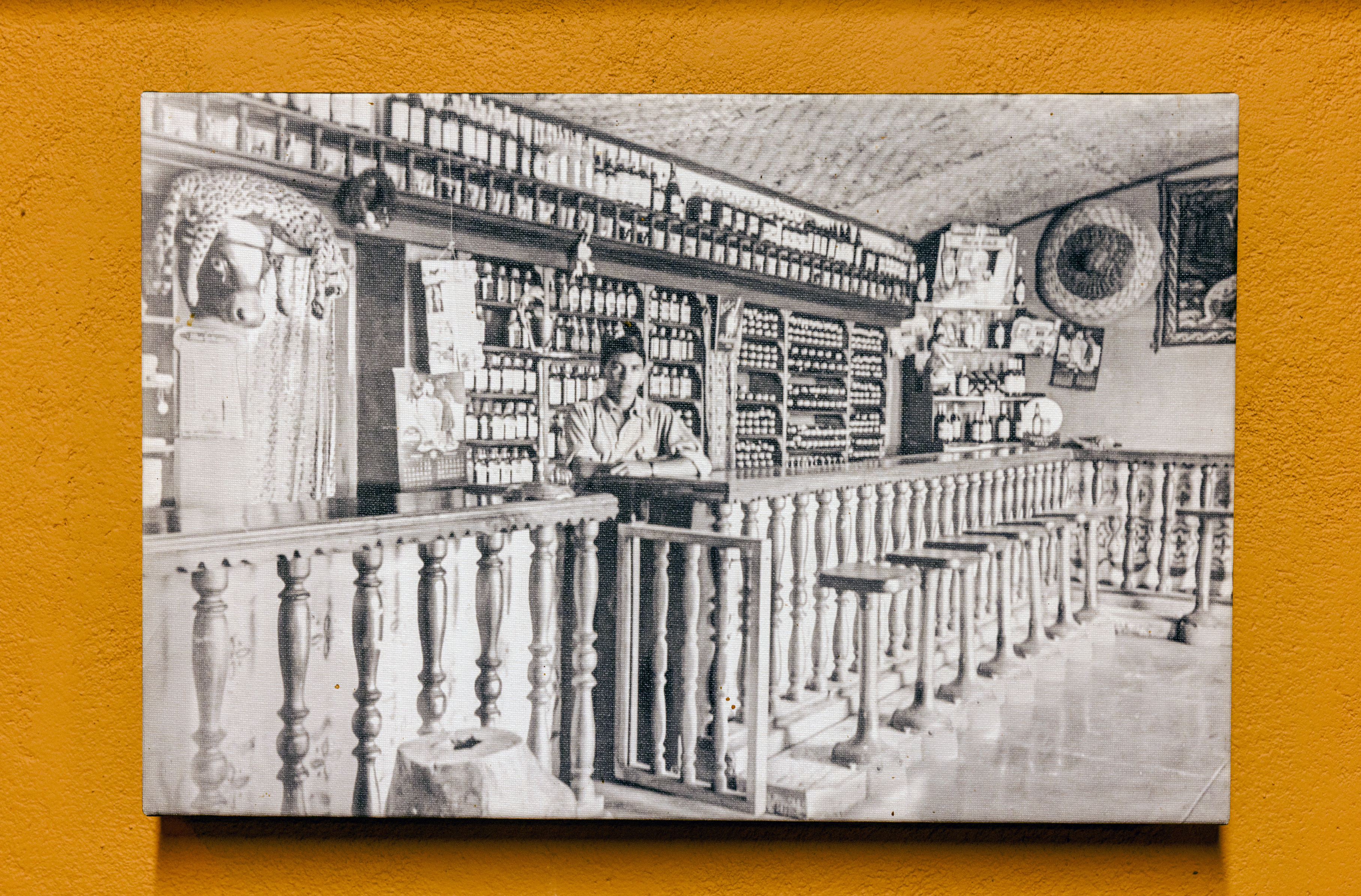
The most distinctive part of the saloon Charlie’s great grandfather built is its actual bar. It looks nothing like the bar at the Crystal Palace or any other bar I’ve ever seen. Its base is plastered with whitewashed adobe and adorned with baluster-like wooden posts that are stained dark brown. “These are actually two by fours with horse glue,” Charlie says, reaching down from the barstool where she sits to touch one of the posts. “A guy down the street owed my great grandfather some money, and so he made these for him.”
Above us, the ceiling is a criss-crossed weave of thatched bamboo that looks like it belongs in the South Pacific instead of southern Arizona. The thatch actually comes from China (by way of Mexico), and it’s supposedly insect resistant and water repellent—if not actually water-tight. “If you ask some of the older locals, they’ll tell you it used to rain inside a lot more than it did outside,” Charlie says.
Tirso Trujillo didn’t preside over his bar very long—he died at age 40. His son, Abe, was only 12 at the time, but he’d already been working at the bar for half his life. He taught his mother—who was now responsible for the business—how to mix drinks and place the beer and liquor orders. When Abe turned 21, in 1950, the Old Tumacacori Bar officially became his, deed and all, and he tended to it until the day he died.
Charlie grew up in the house next door to the bar, but she and her two sisters weren’t allowed inside it during business hours. Their grandfather was strict about that. Still, the thick adobe walls couldn’t keep the joyful energy of the place from seeping through.
“This bar has its own heartbeat, you know?” Charlie says. “I lived right next door, and I would hear these women hollering and hooting and just having the best time. The best time.” She's smiling again. “That was the loudest thing in the world to me as a kid—the sound of women dancing.”
Thinking about this scene—women dancing and laughing in the bar as three little girls listened next door—I can’t help but harken back to something Marshall Trimble told me about how the earliest saloons were essentially men’s clubs. How men didn’t even bother to remove their hats inside a saloon because there were no women around to make polite gestures toward. “The saloon was the social life for a lot of lonely men,” Trimble had explained. “Working on a ranch or down in a mine was a really lonely life, and the saloon was the one place where men could find company.”
This is how an essay on True West Magazine’s blog describes the evolving role of women in saloons: “As women became more liberated, the rules loosened up. She could enter through a side or back door, but no self-respecting lady, with the exception perhaps of Calamity Jane, would dare enter through the front door.” Trimble himself writes in True West that, eventually, “women worked in the saloons, dancing or serving drinks or luring male customers upstairs. But female owners or part owners were rare.”
These days, when it comes to Arizona’s best saloons, a badass female proprietor like Charlie Trujillo isn’t the exception, she’s the rule. The Crystal Palace, the Palace Restaurant and Saloon (in Prescott), the Black Cat Bar (in Seligman), the Drift Inn Saloon (in Globe), Paul and Jerry’s Saloon (in Jerome), the Spirit Room (also in Jerome), the Wagon Wheel Saloon (in Patagonia), the Crown King Saloon & Café (in Crown King) and the tiny Hilltop Bar (in Sasabe)—all are owned or co-owned by women.
The mantle of boss lady, however, seems to sit uneasily on Charlie’s shoulders. The way she sees it, she’s not running a bar so much as caretaking her grandfather’s legacy. Even though Charlie and her grandmother and her mother kept the bar going when Abe wasn’t around—he had a full-time job as a deputy sheriff for Santa Cruz County—she insists he was the reason people came in.
“People gravitated towards him,” she says. “People looked up to him. They always wanted his advice, regardless if it was with marriages or neighbors or finances, they wanted to hear from him.”
Abe Trujillo died in the summer of 2012, a couple of months after 600 people showed up at the bar to celebrate his 81st birthday. For the record, the population of Tumacacori back then was about 400 people.
“When he passed, people couldn't walk in this bar anymore,” Charlie says. “They were like, ‘We can't. We can't go in there.’ And I understood. I couldn't talk about my grandfather for almost 10 years.”
Maybe she couldn’t talk about him, but she could channel him. Because, all those years, she paid attention. She treats visitors to Abe’s Old Tumacacori Bar the way she knows her grandfather would have treated them. Got muddy shoes? No worries. Come on in. Horse need watering? Tie it up out back—and help yourself to the hay. Got caught in a hailstorm on your motorbike? Take off your leathers and warm up. Heck, roll your bike inside the bar if you want. Don’t want to drink? That’s OK. Sit anywhere and stay as long as you like.
“I don’t care if I make a dollar off you,” Charlie says. “If you're being good to people while you’re here and you’re happy when you leave, that’s all I care about.”
I talk to Charlie a long time. I sip an Old Elk bourbon, she drinks water. There are birdwatchers from out of town playing pool, and a mellow golden retriever lies on the floor nearby. Nearly everyone who walks into the bar says hello to Charlie, touching her shoulder or bending to hug her neck. The bartender, a grin-prone young fellow, leans in to hear her stories and is quick to return every time he has to slide away to fill a drink order.
I wonder, as Charlie tells yet another reverential tale about her grandfather, does she see what’s going on here? Does she realize that she’s becoming a surrogate for the respect and affection that was shown to Abe for so long? Sitting on a stool in her boxer’s robe, does she realize how many people are rooting for her?
I’ve come to Abe’s Old Tumacacori Bar with a photographer, and before we leave, Charlie asks a favor: She wants to know if the photographer might take a picture of her family—her and her husband and their four kids. And maybe their cattle dog, too. She says she doesn’t have such a portrait—not one taken by a professional, anyway. The photographer obliges.
I’ve seen that photo. Charlie and her family are posed in front of the bar. Her husband and kids—three girls and a boy—are perched on bar stools. She’s standing at their side, arms crossed, smiling wide. I look at the kids. I wonder which of them will be the one—the one who inherits their mother’s deep love for Abe’s Old Tumacacori Bar and becomes its fifth-generation steward. Whichever kid it is, I hope they’re paying attention.

Back at La Gitana Cantina, Drew Landrith leads me past a wall of framed portraits and out the back door of the bar, where a flatbed Ford pickup is parked on a patch of brittle grass next to the building.
Landrith is a frenetic man, flitting about in cowhide welding jacket and talking loudly, sometimes to no one in particular. His visage is more beard than face, and he wears thick glasses that magnify his eyes. “He keeps getting hit by cars and falling over in the street, but he just won’t die,” the bar’s owner, Villalta, tells me matter-of-factly, without a hint of hyperbole.

Landrith gestures toward the truck, which is battered and rusted and at least 50 years old. “You wanna have some fun?“ he asks. “Get in and we’ll head up that mountain.” He points in the distance, in the direction of Mexico, at craggy and brown Fraguita Peak.
I’m not going to lie: It sounds like a good time. But I tell Landrith that I’m more interested in learning about the display of portraits we just walked past.
“You mean the Death Wall?” he asks.
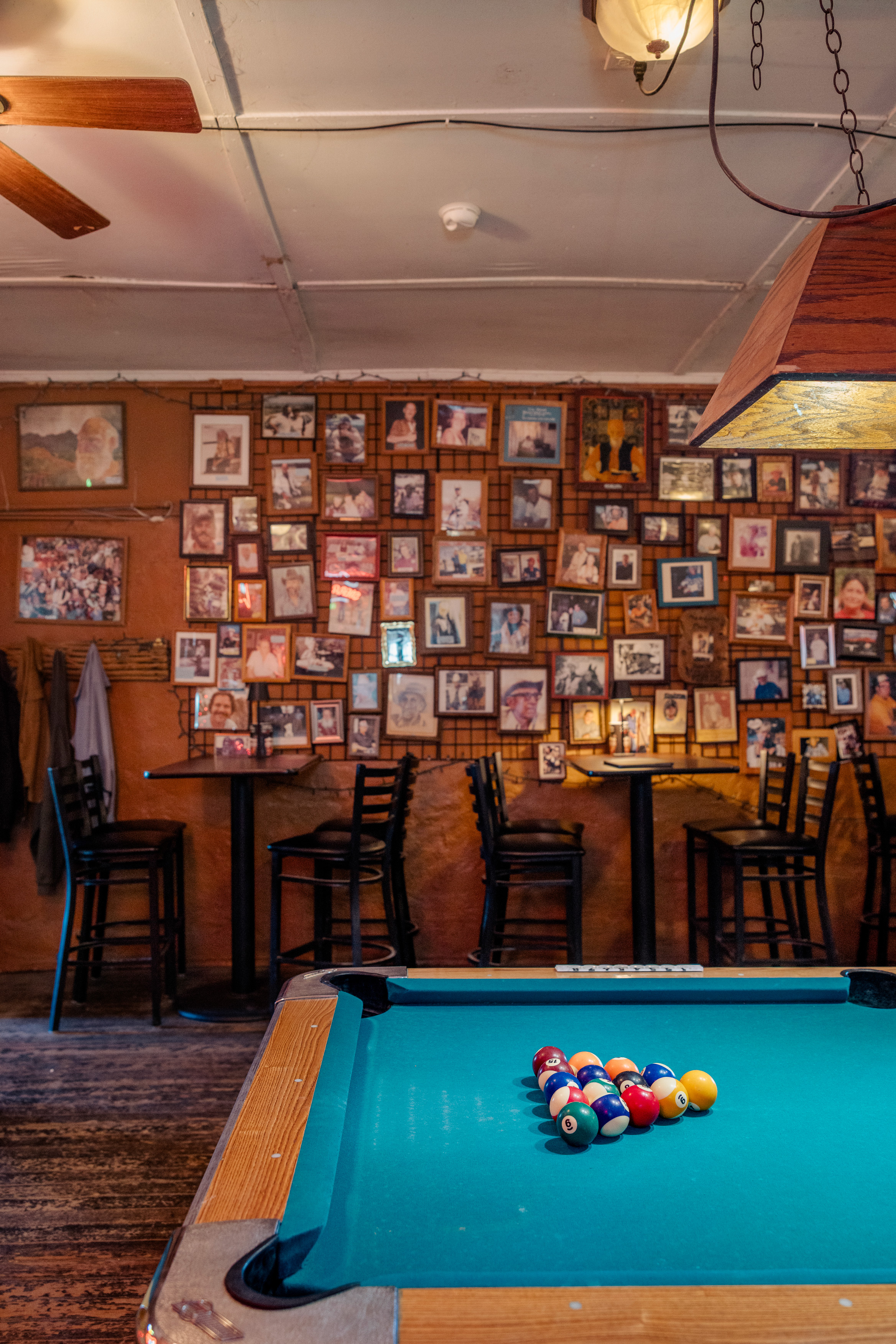

He leads me back inside and we stand before the arrangement of framed portraits, which is a memorial to Arivaca residents who have passed away. The “Death Wall” isn’t just what Landrith calls it—it’s what everyone at La Gitana calls it. Some of the photos are old and faded, others bright and recent. The people in them sit on fishing boats or in backyards or atop horses. A few pose in front of portrait-studio backdrops from the ’70s and ’80s.
Landrith seems to know every face. His hand moves from frame to frame as he states each person’s name and describes their role in the community. This he does in rapid-fire fashion, as if he has more to say than time to say it. A few patrons wander over to listen. At one point, Landrith pauses, his energy seemingly short-circuited. His fingertips touch the glass covering a portrait of a man standing in front of a tire shop. “That’s my dad,” he says. A quiet moment passes, then Landrith keeps going.


That La Gitana is ultimately defined not by the bullet holes in its ceiling but the memorial portraits on its walls should come as no surprise. The earliest saloons were the social hubs of western towns, providing community for the people they served.
If a miner was killed in an accident, the saloon was where people took up a collection for his widow and often where his casket was placed for viewing. The local preacher might deliver his Sunday sermon from a saloon. Saloons doubled as courthouses and town halls and stagecoach stops.
In small towns across Arizona, where miners and ranchers and railroad workers still reside, saloons remain social hubs. They host wedding receptions and wakes, movie nights, fundraisers for families in need.
The Sultana Bar, in Williams, is particularly suited to serving the surrounding community. The Sultana is a classic saloon, built in 1912, with a pressed-copper ceiling and pine-paneled walls adorned with taxidermy. It’s a good-sized room to begin with, and because it’s conjoined with the old Sultana Theatre next door, it’s one of the few spaces in Williams big enough to host dances and concerts, wedding receptions and funerals.
The Sultana is named after an American tragedy almost nobody has heard of: the explosion and sinking of the Sultana, a wooden steamboat carrying more than 2,000 Union Army soldiers up the Mississippi River. (News of the sinking was overshadowed by events of the previous day, when President Abraham Lincoln’s assassin, John Wilkes Booth, was tracked down and killed.) The Sultana’s current owner, Jason Olson, doesn’t know why the original owner picked such a sad event as the namesake for a bar built for good times. But when Olson offers up the saloon’s environs to local families who’ve lost loved ones, he is carrying on a longstanding saloon tradition.
“Anytime anybody in the community passes, if there's a funeral that needs to be held, it takes precedence over anything we’ve got going on,” Olson says. “Not everybody wants the traditional church setting, you know? They want to have a celebration of life where they can relax and have a beer. And, of course, we’ve never charged a dime. We just really appreciate the honor of being able to celebrate people who’ve been living in our town for 50, 60, 70 years.”
As someone who was raised in a Southern Baptist household and attended church three times a week, I find the similarities between saloons and churches so obvious as to be bromidical. I’m not talking about their respective sacraments—although parallels can be drawn there, from last call to benediction, from the jukebox to the pipe organ—so much as their social structure. Saloons, like churches, are places of fellowship, and among their congregants are elders and regulars who can be counted on to share wisdom, give counsel, listen to a confession, tell a joke, talk sports, or just make you feel like you’re a part of something bigger. Or at least less alone.
Brad Knaub is a longtime member of the congregation at La Gitana. He doesn’t look like the sort of guy you’d find in a saloon for miners and ranchers. A thin gray beard swirls from his chin, and small gold hoops hang from each of his ears. He tells me that, since the 1960s, Arivaca has maintained a “vein of counterculturalism,” of which he is a part. When I ask him what he does for a living, an awkward silence precedes his reply. “Back in the day, you wouldn’t have wanted to ask that question, because a lot of what people did was illegal.” Then he grins and tells me owns a coffee-roasting business.
“There used to be signs around town—‘Hippies Not Welcome,’” Knaub says. “But not in the bar. Everything was always cool in the bar. Everybody always got along—the cowboys, the hippies, the Mexicans. The bar was for all of us.”
Good stuff. Warms the heart. But let us not sanctify the saloon beyond reason. For saloons do not exist for the sake of family funerals or communion between hippies and cowboys. They exist to serve alcohol. And as Knaub raises a bottle of beer to his lips, I think to myself that maybe the simplest answer to the question of why saloons endure is that hard-working people, no matter the century, enjoy a stiff drink when the day is done.


The very first “saloons” in Arizona were shanties in the wilderness that consisted of little more than a wood plank with a couple of bottles of whiskey and a single tin cup. According to Bradley G. Courtney, author of “Prescott’s Original Whiskey Row,” that’s just the sort of primitive saloon that was erected in (or near) Prescott in 1864 by an enterprising pioneer named Isaac Goldberg. His customers, Courtney writes, were gold miners who “sought escape by intoxication from the toil of making a living in the surrounding mountains.”
Goldberg’s makeshift bar in the woods would eventually begat the most famous collection of saloons in Arizona: Whiskey Row.
Whiskey Row, which today occupies a stretch of Montezuma Street across from downtown Prescott’s picturesque Courthouse Plaza, comes by its name honestly—it has liquored up cowboys, miners, soldiers, politicians, businessmen and tourists for more than 150 years. But there’s always room for exaggeration. Several sources state that, during its early 20th Century peak, Whiskey Row packed 40 drinking establishments within a single city block. That’s probably a stretch. Courtney says there were probably fewer than 20 saloons on the Row, the first of which was built in 1868 and called the Diana.
These days Whiskey Row boasts “only” a half-dozen saloons. There’s the Jersey Lilly, with its balcony overlooking the plaza. There’s the Bird Cage, with its Brunswick back bar and namesake collection of taxidermy birds. And there’s Matt’s Saloon, where Bruce Springsteen, at the height of his fame, once dropped in and jammed with the house band (and then paid off the medical bills of a cancer-stricken bartender named Bubbles).
But the crown jewel of Whiskey Row is the Palace Restaurant and Saloon. If Courthouse Plaza is the living room of Prescott, then the Palace is its parlor. The Palace is the oldest bar in Arizona, having begun life in 1874 as the less regally named Cabinet Saloon. It has burned multiple times, most famously in the Great Fire of 1900, when, as flames lapped at the Palace’s walls, patrons (most likely with help from horses) drug its ponderous bar across the street and into the plaza. They then propped their elbows on the bar’s cherry-wood top and kept drinking as Whiskey Row burned to the ground. This rescued bar, legend has it, is the one that still sits in the Palace today.
It’s a good story, and it’s probably true. What’s irrefutably true is that, a year after that fire, the Palace was reborn as one of the grandest saloons in the West. The rebuild cost $50,000—the equivalent of $1.6 million today. But the Arizona Weekly Journal-Miner, in its coverage of the reopening, dedicated a lot of ink to a part of the saloon that, at least according to the legend, wasn’t new: the bar.
“The bar and fixtures … are without doubt the most elegant in this part of the country and in fact there is nothing finer built,” the Miner gushed in its July 3, 1901 edition. The article goes on to say the back bar, with its columns and carvings and mirrors, “causes one to look at it with wonder and amazement.”
The Palace today doesn’t look quite like it did back then, but it’s pretty dang close. Credit for that is due former owner Dave Michelson, a San Diego restaurateur who moved to Prescott in the mid-’90s to give his children a simpler life and ended up adopting another baby: the Palace. Michelson fell in love with the old saloon, even though it had descended into a state of stale-beer shabbiness. Windows were boarded up. The tin ceiling was blackened by cigarette smoke. There was a pool table in the middle of the kitchen. And, in the most egregious insult to the Palace’s storied history, the front bar had been crudely extended with plywood and mismatched stain.
Michelson took over the Palace’s lease in 1996 and went to work restoring the place to its former glory, based on historical photos he pored over at Sharlot Hall Museum. Here’s how the Arizona Republic described the saloon’s most recent metamorphosis: “Workers sanded and refinished the bar and hardwood floor. Walls were repaired and 100 years of smoke was erased from the tin ceiling, which was then repainted by artists lying atop scaffolding, a la Michelangelo and the Sistine Chapel.”
And, of course, Michelson ripped out the plywood abomination affixed to the legendary bar—a bar so famous that descendants of John Brunswick, the Swiss-born immigrant who founded the company that built it (and so many other bars that graced high-end saloons in the Old West), traveled to Prescott to see the bar in person.
“I met them,” says the Palace’s current owner, Martha Mekeel, who was tending bar at the time. “They came all the way out from the East Coast to see it. They told me, ‘This bar is part of our family lore.’”
I’ve arranged to visit the Palace at 9:30 a.m., before it opens for business. I enter through the back alley and walk into the main room, its wainscot polished to a shine, its walls painted wine red, its glossy tin ceiling rising 25 feet above. Morning light slants in from the streetfront window, glinting off the golden-brown eyes of mounted elk and framed black-and-white photos of Earps. The rest of the place—empty tables, upturned chairs, a nattily attired bartender marrying bottles of cranberry juice—is left in shadow. It looks like a scene Caravaggio would paint if Caravaggio had painted saloons.
In an obligatory attempt to commune with history, I run my hand across the bar. But I’m distracted by what’s behind it. I see Old Fitzgerald, Elmer T. Lee, Colonel E.H. Taylor, Pappy Van Winkle and darn near the entire Weller line. The crown jewel of Whiskey Row should serve decent whiskey, and the Palace delivers.
Mekeel, who worked at the Palace for five years before rising to proprietorship in 2018, claims partial credit for that. When Michelson owned the place, she says she needled her then-boss (and now friend) for refurbishing the extraordinary back bar only to populate it with bottles of ordinary whiskey.
Mekeel, who doesn’t drink, says head bartender Nick O’Neal actually executed the plan to bring better whiskey to the Palace. O’Neal is the aforementioned barkeep who was doing prep work when I arrived. He wears a neatly trimmed beard and utilitarian spectacles, and he politely tolerates my behind-the-bar perusal of the Palace’s whiskey lineup.
I nod toward a bottle of rare O.F.C. bourbon. “How much do y’all charge for that?” I ask.
“Five hundred bucks for an ounce and a half,” O’Neal says.
“When’s the last time somebody ordered it?”
“I had a couple of guys order it just the other night.”
“Were they celebrating something?”
O’Neal shrugs. “Nah. They just wanted to try it.” Then he goes back to polishing glasses.
Besides $500-a-shot whiskey, there’s one other thing the Palace has that other Arizona saloons don’t: swinging doors.
They are almost certainly not original. The Arizona Weekly Journal-Miner, in its 1901 article about the Palace’s grand reopening, states that patrons entered “through massive double doors of solid oak,” with no mention of swinging doors. The oaken double doors still exist, but now they open into a small vestibule, and a pair of batwing swinging doors serve as the wooden veil that separates Whiskey Row’s most famous saloon from the world outside.
I couldn’t care less about the historical authenticity of Palace’s saloon doors. I just want to walk through them. I want to push them open and imagine the saloon as it would have been in its post-fire prime, with cigarette smoke wafting toward the tin ceiling and miners exchanging gold dust for whiskey at Mr. Brunswick’s bar. Seeing as how I’m already inside the place, I must walk out to walk in, so at the stroke of 11 a.m., when the Palace’s longtime maître d clops across the hardwood floor in his cowboy boots to prop open the outer doors for business, I make my move.
As I reach the swinging doors, I see that a family is entering from the other side. With a toddler. And a baby in a stroller. I step aside and hold one of the doors open so they can pass. The bow-legged toddler waddles drunkenly into the saloon, and the stroller follows. I nod at the parents. They smile and say thank you. Then I rest my forearm on top of the batwing door and watch, with squinted eyes, as the family settles in at a table next to the one where I’ve left my iPad.